

Don’t Make Covington's Mistake
What a Snake-Handling Journalist Taught Me About Studying Religion

Tomorrow I start teaching again. Good-bye sabbatical, for now.
An academic sabbatical, which I can apply for every six years, means time for research and writing without any teaching or what we call “service,” all the work professors do to keep our institutions running like serving on committees, preforming administrative tasks, and running programs. It’s been amazing, and why I’ve been able to share so much writing with you here. But this Wednesday I’m back in the (virtual) classroom, starting my summer intensive: Sexual Ethics in Judaism, Christianity, and Islam, or what I call Sex in Three.
I teach it online in the summer because a lot of Northeastern students are still on one of our signature co-ops, so out in the world doing real jobs, and a summer online format lets them knock out a requirement while they’re finishing their paid internships. But no matter when I teach Sex in Three, it has a waitlist. It is also one of my favorite courses to teach because the material is spicy.
I always start the same way and I wanted to share how, because I think the first week’s framework has applications far beyond a college classroom.
Let me start with the piece I assign in the first weekmevery time I teach this course: Chapter Six of Robert Orsi’s book Between Heaven and Earth: The Religious Worlds People Make and the Scholars Who Study Them (Princeton University Press, 2004). The chapter’s title is “Snakes Alive: Religious Studies Between Heaven and Earth.”

Robert Orsi is a historian of religion at Northwestern, and he’s one of the most important scholars in the field. He grew up Catholic in the Bronx, and his work on saints, suffering, and the messiness of lived religious practice shaped how I think about what we’re actually doing when we study religion. His piece “Snakes Alive” is a critique of a journalist named Dennis Covington, and I use it because sets up my students in a very specific way for the rest of the course.
Covington was a reporter for the New York Times who was sent down to Appalachia to cover a trial: a snake-handling pastor had been accused of attempting to murder his wife by forcing her hand into a box of poisonous snakes. Covington goes down to cover the case, but he ends up staying. He embeds himself in the community of snake-handling Christians for two years and writes a bestselling book about that experience called Salvation on Sand Mountain.
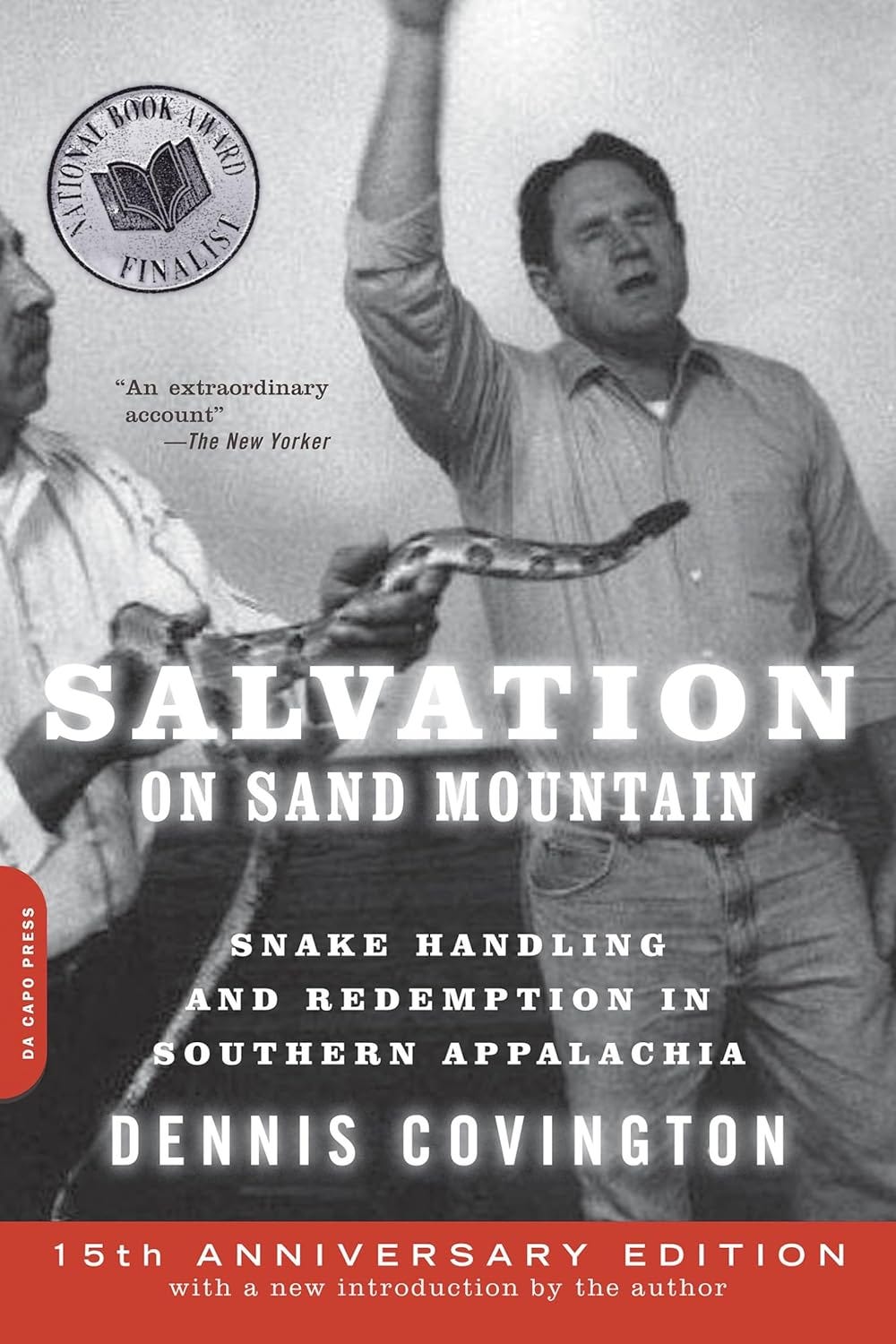
And for most of that book he takes these people seriously on their own terms. He doesn’t treat them as a curiosity or a freak show. He hangs out. He participates. He smells what he describes as the “sweet savor” of the Holy Spirit when the snakes come out of their boxes. He handles snakes himself. He comes to understand snake handling as a way the poor, displaced people of this community contend with the violence and danger in their everyday lives. Orsi calls it “an engaged, interpersonal, and participatory” model of religious studies. High praise.
But then comes his last night on Sand Mountain.
At a church service Covington’s photographer, a female colleague he’s close to, is verbally attacked by a minister named Punkin’ Brown for assuming a role the congregation believes Scripture assigns to men. Covington is appalled. He rises, in what becomes the emotional climax of the book, to deliver what Orsi calls a declaration of liberal feminist equality. These people, Covington concludes, are backwards and sexist after all. We were was right to be suspicious. They are wackadoos.
Orsi argues that while at first glance it looks like Covington is preforming the sort of research religious studies scholars would approve of, in the end what is he really doing is inscribing “an existential circle.” Covington started with genuine engagement, but then he used that engagement as the justification to confirm the stereotypes he started with. In my first book I confessed to doing something similar during fieldwork in Iran, and called it “academic ventriloquism” since I was “throwing my voice,” using my research subjects to confirm what I already thought I knew to be true.
Similarly, Orsi argues that Covington’s feminist declaration isn’t really about the female photographer. It’s about Covington. It’s the moment he reestablishes the border between himself and the community, the moment he presents the snake handler Punkin’ Brown as a “vile, primitive force,” a creature, practically a snake himself. It reassures Covington, and his readers, that whatever fascination drew them into this world, they were never really in danger of having to take it seriously.
Here’s what Orsi says Covington could have done instead. He might have explored the roots of Punkin’ Brown’s anger. He might have sat with the intersection of desire and rage in the snake handlers’ world, looked at the convergence of love and pain in how they experienced the sacred. He might have reckoned with his own obvious attraction to snake handling, and his own complicated, eroticized gaze at the women in the community, which Orsi points out Covington never examines (and if Covington was really interested in feminist analysis, this would have been a place to dig in). Instead, at the moment of maximum discomfort, he invokes a principle and turns away.
I want to be clear about something. Neither Orsi nor I am arguing that the spiritual equality of women is not worth asserting. It is. The question is what it means to invoke that principle in that moment, in that way, against that community. Orsi’s point is that invoking our progressive values as a way to stop engaging with something we find disturbing is not feminist solidarity. It’s a way of protecting ourselves from the genuinely destabilizing possibilities of encountering another world. And it gets in the way of learning and understanding.
There’s a word Orsi uses for the feeling that can happen when we study the religion of others: the recoil reflex. That initial flinch when a religious practice seems bizarre or threatening or morally wrong. He doesn’t say you shouldn’t have it. We all have it. He says you should name it, acknowledge it, and then try to set it aside long enough to understand what you’re looking at, on its own terms.
This is what Orsi calls “the third way.” Not defending a tradition from the inside. And not what he thinks Covington ultimately does, judging religious communities by secular progressive standards. The third way is characterized by what he calls a “disciplined suspension of the impulse to locate the other securely in relation to one’s own cosmos” (198). It’s a willingness to make your own self-conceptions vulnerable to what an encounter with an unfamiliar way of life might reveal about yourself.
Not the abandonment of your values. But a commitment to staying in the difficult in-between place long enough to learn something about the community you’re studying, and about yourself.
This framing matters for my students because Sex in Three is designed to challenge them from multiple directions. Some of my students come in with a conservative religious background and find the material disturbing because it’s too permissive and ask, why are we taking seriously traditions that allow this? Others come in as secular progressives and find it disturbing because it’s not permissive enough and ask, why are we taking seriously traditions that restrict that? And then there are the topics we study like plural marriage and genital cutting. Almost everyone in this course hits their own version of the Punkin’ Brown moment. The moment they want to close the book and walk away.
And I make them stay in it.

Here’s why I’m sharing this with you.
A lot of people who find their way to this Substack describe themselves as spiritual but not religious, or religiously curious, or somewhere in the long uncertain middle between belief and skepticism. Many have walked away from a tradition that hurt them, or never had one to begin with, or find themselves genuinely drawn to practices that come from traditions they don’t fully belong to and aren’t sure they should claim.
That’s a real and complicated place to be. And I think Orsi’s third way is a map for navigating it. Not just a methodology for scholars, but an orientation for anyone trying to engage seriously with religious and spiritual life without either recoiling from it or romanticizing it.
Here’s how the recoil reflex might show up for you. The dismissal of a belief or practice as superstitious, or primitive, or irrational. You might think, this is not for people like me, not something I need to take seriously. That’s Covington at the end of his book. It’s a way of protecting yourself from the unsettling possibility that something you don’t understand might actually have something to teach you.
But the opposite move is just as problematic. Treating a practice as profound just because it’s new to you, or ancient, or from somewhere far away. That’s its own kind of refusal to engage. It’s romanticization as a substitute for understanding. You’re not really entering another world; you’re projecting onto it what you wish your own world had.
The third way asks something harder from you. It asks you to stay in the discomfort of genuine encounter with a tradition, a practice, a community, or a set of ideas about the sacred that may challenge your own long enough to actually learn something. Not to surrender your values. Not to pretend that everything is equally good or that nothing should be questioned. But to make yourself, as Orsi puts it, “vulnerable to the radically destabilizing possibilities” (198) of an unfamiliar way.
That’s what I’d call religious literacy in the deepest sense. Literacy is not about being able to recite facts about traditions or quote scripture. It is knowing how to be curious without being credulous, critical without being dismissive, and open without losing yourself in the process.
If you have been a reader for awhile, you know I don’t have a religious affiliation and I’ve spent my career studying traditions I don’t belong to. But what I have come to believe is that this posture of disciplined, generous attention is itself a kind of spiritual practice. It doesn’t tell you what to believe. But it does change how you see.
That’s what Religion Reimagined is about, for me.
It’s also, I’d argue, the foundation for any genuine spiritual community: one that can hold real difference without collapsing into either judgment or false unity. The third way isn’t just a personal posture. It might just be what a pluralist spiritual life together requires.
My book Beyond Wellness is out now (hooray!) and explores how this same logic plays out in contemporary spiritual wellness culture.

“Projecting onto another tradition what you wish your own world had”. I see this so much in eg communities that work with Tibetan Buddhist lineages. Which offer profound and effective practices. People will be moved by texts, experience realistic visualizations. Yet not engage with the very real geopolitical challenges now facing America. Or not examine the underlying metaphysical assumptions, where emptiness easily slides into bypassing
The third way is difficult. Glad you are encouraging it.
I am 69-grew up in a central Illinois in a Methodist church. Our family attended Sunday school VBS, parents taught and served in numerous church ministries over their 50 years. But….. every summer we would pack up a used pop-up trailer and head out of town- sometimes up to a month ( both parents teachers- so summer!) They took us to different churches all over the US- from visiting a Mormon church in Utah, Ebenezer Baptist, Mennonite in WI, SBC in Texas, large Catholic cathedrals in major cities. Numerous discussions in the car about experiences, theology, practices, dress codes , etc. But never judgment. I am so grateful to them for their curiosity and willingness to be uncomfortable at times They tried to help us understand there was a “reason”, even if they didn’t agree with it, behind faith practices.